

Kinross Raingardens Trail 25-26
Over the past few years, the Kinross-shire Civic Trust has been working on a series of projects aimed at bringing wildlife back into everyday places - from park and ride edges to floodplains and smaller wetlands. This latest phase, supported by the Nature Restoration Fund, builds on that work by focusing on the South Queich catchment and continuing efforts to create new habitats where they’re most needed.
At the centre of the project is a simple idea: ponds matter. Especially for amphibians.
Across the UK, species like the common toad have seen major declines, largely due to the loss of suitable habitat. Creating small ponds and wet areas might seem like a modest response, but they can make a real difference - providing breeding sites, shelter, and feeding areas where none existed before.
That idea has already been put into practice in Kinross. Earlier work in the South Queich floodplain created new ponds, and it didn’t take long to see results -amphibians moved in, and the surrounding area quickly became richer in both plant and insect life.
This new phase takes things a step further.
Based on a detailed survey of the catchment, new pond sites have been identified, including locations at Balado and within Forestry and Land Scotland’s Dunning Glen. Each site has been picked because the conditions are right, whether that’s water retention, soil type, or how it fits into the wider landscape.
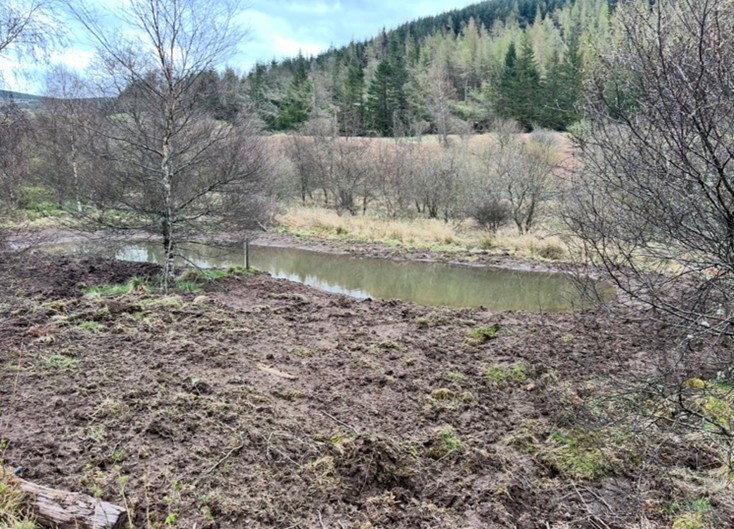
At Balado, three ponds have been created and linked by a narrow channel, allowing water to move between them and maintain more stable conditions. At Dunning Glen, a single larger pond has been dug in an area where the water table is naturally high, helping it to fill and sustain itself.
It’s early days, but already the changes are visible. The ponds begin to fill almost straight away, and as water settles, the next stage begins - plants move in, insects follow, and gradually the whole system starts to build.
The work doesn’t stop at digging ponds, though. Later stages of the project involved seeding and planting around the edges, creating a more complete habitat and making the sites more attractive to wildlife. Over time, these areas should become part of a wider network of habitats across the catchment.
Rather than isolated features, these ponds act as stepping stones, small but important links that help species move through the landscape. In areas where development and land use change have reduced habitat, those links can make all the difference.
The ponds will be monitored over time to see how they develop, and that learning will feed into future projects. What works well here could be used elsewhere across Kinross-shire and beyond.
Like a lot of projects like this, it’s built on collaboration. Surveys, design work and monitoring all feed into the practical work on the ground, while local support - both from organisations and volunteers - helps keep things moving forward.
If you visit the site, you’ll likely see the difference: more plants around the edges, more insects in the air, and the tell-tale movement of amphibians in the water.
COMMENTS
Other Blogs

Woodland Creation Advice Note
Perth & Kinross Council encourages landowners to contact the Woodland Enquiries service early in ...

New Urban Forestry Fund
New funding opportunity from Future Woodlands Scotland for projects between £2,000 and £100,000. App ...
Nature Restoration Fund 2024/25 Open for Applications
The Nature Restoration Fund for 2024/2025 is now open for applications. ...


Tackling Invasive Species on the Almond
The River Almond Invasive Non-Native Species (INNS) project is an ambitious partnership project aimi ...
Perth & Kinross Nature Restoration Projects 23-24
Perth & Kinross Council approved projects to spend £353,000 of Scottish Government’s Nature Rest ...

Rewilding Denmarkfield Wildflower Meadow Creation Project
Learn about the 3.15ha species rich grassland corridor Rewilding Denmarkfield have restored along th ...

Glassie Bike Park Rewilding
Thanks to PKC Nature Restoration Funding, Glassie Bike Park were able to re-establish their woodland ...

Kinross Raingardens Trail
Learn about the great work Kinross-shire Civic Trust have been carrying out to expand their Rainwate ...

Crook and Drum Growing Together Community Orchard
Read about the work Crook and Drum Growing Together have been undertaking to extend their community ...

Riparian Habitat Restoration Riverside Perth
Read about the work Beautiful Perth have been undertaking to restore riparian habitat at the Riversi ...
Perth & Kinross Nature Restoration Projects 22-23
Perth & Kinross Council approved projects to spend £193,000 of Scottish Government’s Nature Rest ...

TREE-MENDOUS LEARNING IN PERTHSHIRE
Perthshire, home of Big Tree Country, is known and loved for its wonderful trees. From the Tay Fores ...

Managed for Wildlife Trials Consultation
On the 7th February 2022, Perth & Kinross Council's Community Greenspace Team launched the ‘Mana ...

Nature Calls - Bin The Wipes
Scotland is being urged to bin all wipes – and ban wipes containing plastic - in a major new campaig ...

The Perth Nature & Biodiversity Conference
In December 2019, the Perth City Leadership Forum (PCLP) held a conference to discover how Perth mig ...